

Travel
Stunning
by JOHN GODDARD
Cold from the marble floor seeps up through a thin carpet, chilling our bare feet.
Men in turbans drape garlands over a golden palanquin, and chant - the same line over and over, not quite in sync.
It is 4:30 a.m.
A bass drum sounds. Swarms of people coalesce and, out of the shadows, a granthi emerges with an oversized book on his head.
Devotees press closely, tossing rose petals, and when the granthi lays the book on the palanquin's brocade pillows, the crowd proceeds ceremonially toward a floodlit temple in the distance.
I am visiting the Golden Temple of Amritsar.
More properly, I am visiting the Harmandar Sahib - spiritual centre of the Sikh faith and one of the world's most stunning religious sites.
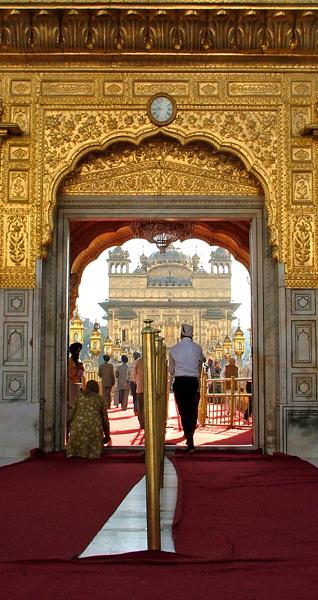
A temple of gold rises from the centre of a large reflecting pool, in turn rimmed by a marble promenade and an assembly of ornate 16th-century shrines and watchtowers.
The refreshing waters, the polished marble, the extravagant spaciousness at the centre of an otherwise congested and chaotic Indian city - all stir additional feelings of serenity and goodwill.
The site is open to all, at no charge. A mass kitchen serves free meals of chapati and daal. Throughout the complex, sacred music from the temple orchestra can be heard live from small speakers.
"Even visitors without a religious bone in their bodies cannot fail to be moved," says the Rough Guide to India.
I arrived particularly early.
Most guidebooks say to come when the first morning light illuminates the golden domes. Instead, I took a tip from Benjamin Walsh, a keen Indophile and co-manager of Toronto's Nicholas Hoare bookstore, who recommended being there by 4:30.
Every night, before the main temple is washed with milk and water, granthis remove the Sikh holy book, the Guru Granth, to a secondary temple. And every morning, they return it with a dramatic procession popular among the faithful.
An easy taxi ride brought me to the north gate, where I checked my shoes and socks, donned an orange head scarf borrowed from the hotel, and after washing my feet stepped through a grand archway.And there - on the water - shone the temple.
Customarily, worshippers bear left and circumambulate the reflecting pool clockwise.
But I didn't know that. Instead I turned right, heading for a knot of people near the causeway gates, where devotees were readying the gold palanquin..
Quickly, our numbers grew to more than 300.
When the carriers picked up the palanquin, we followed them onto the causeway. When a priest recited the vaaq, the message of the Lord - a passage from the scripture taken at random - we stood in silence. Then the line moved forward again and I arrived inside.
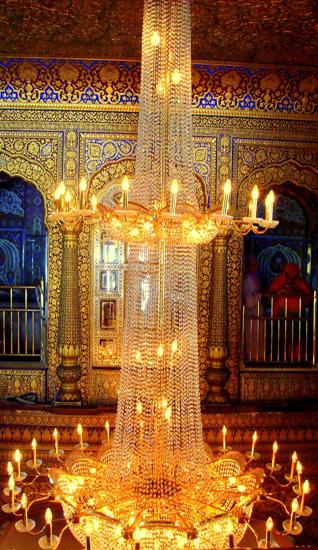
I saw chandeliers, flowers, gold-leaf ceilings, embedded jewels in the floor, worshippers crowding around. Unexpectedly, the room seemed small and overwhelming.
A granthi sat under a bejewelled canopy reading from the Guru Granth.
As the line shuffled ahead, I fixed on the small orchestra to one side.
Then the line moved again, returning me outside. For the rest of the morning, I wandered in the buoyant atmosphere.
As I left the complex, I spotted a music store across the street, a loudspeaker relaying the music from the temple.The singer was Bhai Sarbjit Singh ji, said the shopkeeper. To preserve something tangible from the day, I bought one of his CDs.
[Courtesy: The Toronto Star]
March 29, 2010
Conversation about this article
1: M. Singh (Toronto, Ontario, Canada), March 29, 2010, 5:13 PM.
Why do they wash the floor with milk? Why not some synthetic soaps instead?
2: Sangat Singh (Kuala Lumpur, Malaysia), March 29, 2010, 8:29 PM.
In his book, "My Reminiscences", Rabindranath Tagore recalled his visit to Amritsar fondly, as follows: The Golden Temple of Amritsar comes back to me like a dream. Many a morning have I accompanied my father to this Gurudarbar of the Sikhs in the middle of the lake. There the sacred chanting resounds continually. My father, seated amidst the throng of worshippers, would sometimes add his voice to the hymn of praise, and finding a stranger joining in their devotions they would wax enthusiastically cordial, and we would return loaded with the sanctified offerings of sugar crystals and other sweets. One day my father invited one of the chanting choir to our place and got him to sing us some of their sacred songs. The man went away probably more than satisfied with the reward he received. The result was that we had to take stern measures of self-defence, such an insistent army of singers invaded us. When they found our house impregnable, the musicians began to waylay us in the streets. And as we went out for our walk in the morning, every now and then would appear a tambura, slung over a shoulder, at which we felt like game birds at the sight of the muzzle of the hunter's gun. Indeed, so wary did we become that the twang of the tambura, from a distance, scared us away and utterly failed to bag us. When evening fell, my father would sit out in the verandah facing the garden. I would then be summoned to sing to him. The moon has risen; its beams, passing though the trees, have fallen on the verandah floor; I am singing in the Behaga mode: O Companion in the darkest passage of life ... My father with bowed head and clasped hands is intently listening. I can recall this evening scene even now."
3: Pashaura Singh (Riverside, California, U.S.A.), March 29, 2010, 9:29 PM.
Milk is the symbol of purity in gurbani. In particular, 'dudh karam ('milk-like actions') refer to "pure actions" performed with good intentions. It is an ancient tradition to wash the sanctum sanctoram of the Golden Temple with milk and water. The maryada at the Darbar Sahib is very well-established since the days of Guru Arjan. The Sikh community has preserved it for more than 400 years.
4: Kanwarjeet Singh (Franklin Park, New Jersey, U.S.A.), March 30, 2010, 1:24 AM.
Dr. Pashura Singh ji, I disagree with your comment. Sikhism would never advocate washing the marble or any stone with milk in the name of purity. Purity comes from the naam and nothing else. On one hand the Gurus asked us to refrain from following senseless traditions and "karam kand" such as washing moortis with stone, so why would they ask us to wash the stone with milk. This is a more recent custom that started in the early 20th century by some misled sangat and became a so-called tradition. Do you think the Gurus would want us to waste milk while millions go hungry? In fact the Gurus focused on building the sense of sangat rather than stone buildings, e.g., gurdwaras (with due respect).
5: Irvinder Singh Babra (Brampton, Ontario, Canada), March 30, 2010, 7:34 AM.
I agree with you, Kanwarjeet.
6: M. Singh (Toronto, Ontario, Canada ), March 30, 2010, 1:38 PM.
I might not be an expert in Sikh or Indian traditions but I don't really see the purity in washing with milk. Milk has nothing related to the actual function of cleaning. I would consider normal soap to be a better choice.
7: Pashaura Singh (Riverside, California, U.S.A.), March 30, 2010, 6:48 PM.
I appreciate the comments of S. Kanwarjeet Singh concerning the washing of marble with milk inside the Golden Temple. Maryada in the Darbar Sahib is unique in many ways. Your suggestion that it was introduced in the early twentieth century needs to be substantiated with evidence. That was the peak of the Singh Sabha period. How come the Singh Sabha reformers allowed the introduction of this tradition if you think it was based on the notion of pollution and purity (as it might be the case in the Hindu tradition)? What kind of essentialized "Sikhism" are you talking about? Look at the "lived reality" and then try to make sense of it. No one can raise the 'jaikara' after the ardaas in the Darbar Sahib although it is a universal practice in all gurdwaras throughout the world. If such criticisms are valid, then why doesn't the panth replace the existing practice with some "synthetic soaps" as was suggested earlier in the post. I mean no offence to any body.
8: T. Sher Singh (Guelph, Ontario, Canada), March 30, 2010, 7:39 PM.
I agree with Dr. Pashaura Singh ji - washing the marble floor with milk every morning is an old tradition, and it has nothing whatsoever to do with Hindu or brahmin practices. The Guru Granth Sahib is our Living Guru. We treat it like royalty - all the accoutrements and protocol around it reflect that one central fact. The idea of using milk, in addition to water, was to give honour to the royal presence. Some traditions - but not those that are oppressive, hurtful, etc. - deserve continuity. The argument that the milk could be used for the poor is a lovely sentiment but doesn't go very far in reality, particularly in India. If that was the sole criteria, much of what you and I do in our daily lives would have to be dismantled.
9: Sangat Singh (Kuala Lumpur, Malaysia ), March 30, 2010, 11:30 PM.
We seem to have difficulties for every solution. Might I throw a tiny spanner in the works? Talking of waste, thousands of brides, when departing from their 'babul's threshold, throw rice, and on arrival at her new home the mother-in-law would pour oil as a welcoming norm. All a national waste. What sayeth thou? Then, of course, at wedding receptions to have 20 -30 dishes is a norm, not to mention of the river of alcohol that flows. Wouldn't it be better if we looked inwards and listen to Farid: "Aape savaareh mai mileh mai mili-aa sukh ho-ay" [GGS:1382.18] - "If you reform yourself, you shall meet me, and meeting, you shall be at peace."