


Columnists
The Street
T. SHER SINGH
DAILY FIX
Tuesday, June 19, 2012
During all of my teen years, we lived on a street called Budh Marg … literally, the Road to Enlightenment.
Being the main roadway between our city of Patna and the town of Gaya, some 100 kilometres away, the name was obviously connected to Gautam, the Buddha, who attained enlightenment 26 centuries ago, while meditating under a great banyan tree in that very community.
The tree still exists in massive splendour and receives pilgrims from around the world.
Patna’s Budh Marg was an important artery because it served many of the crucial needs of the provincial capital.
No more than a few hundred yards away in one direction was the Ashok Cinema, named after a personage from more than two millennia ago: the great Emperor Ashok who used this very city - then a great metropolis called Pataliputra - to rule over the greatest empire this part of the world had (and has) ever known. It was from here that he helped spread the then nascent faith of Buddhism … to Sri Lanka, Afghanistan, China.
Now, he was remembered as the name of the movie theatre.
A few hundred yards further, yet another cinema. This one called Pearl … who knows why.
Between the two theatres lay the building which housed The Searchlight, one of the two English dailies that informed the town of the goings-on in the rest of the world.
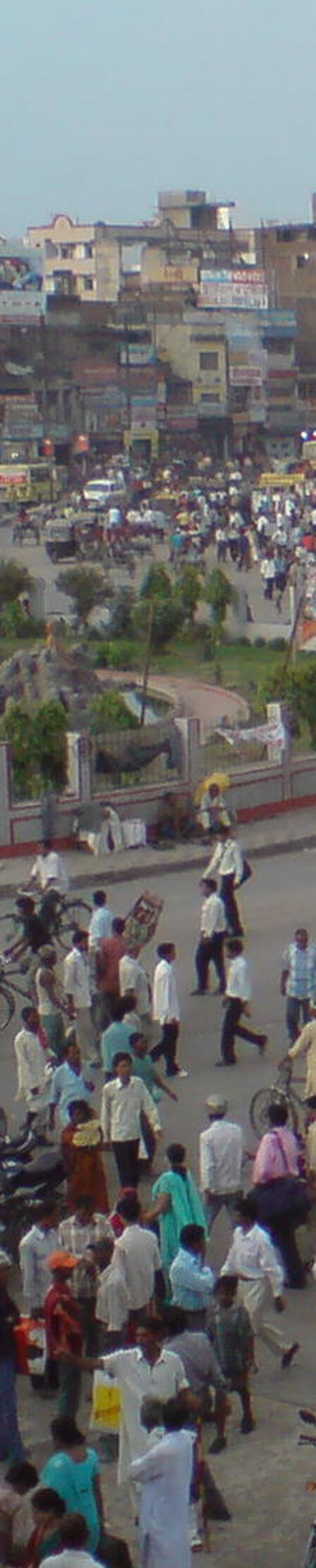
Each of the three institutions was a reliable source of traffic jams, and therefore a constant stream of humanity past our house.
The two theatres, along with four others in the city, provided the primary source of entertainment for the rich and the poor and all those who fell in between. Each with three screenings every evening, of which each was almost three hours long, provided the pulp and fantasy that came down a steady pipeline from the ever busy studios of Bombay.
On Sunday mornings, they had an additional offering of an “English’ movie, to cater to those, I presume, who read The Searchlight and the other English daily, The Indian Nation, in preference to those in the local vernacular.
[The two papers were also amongst the first ones to humour me by publishing my earliest journalistic scribblings.]
The Searchlight building too clogged up the traffic by pointing its huge illuminated news bill-board directly at the road. Cricket scores were the biggest draw and were guaranteed to stop the traffic for hours, until it re-routed itself in some instinctive way, like rivulets finding their own way out when the stream gets dammed.
News headlines too were a big hit, but at least allowed the traffic to flow by in a trickle. Unless, of course, the board screamed: “Kennedy Cut Down By Assassin!”, or “India Liberates Goa!”
Such occasions, I recall, necessitated updates at short intervals, just like cricket scores. The news-hungry crowds merely waited outside all day - or night - for developments.
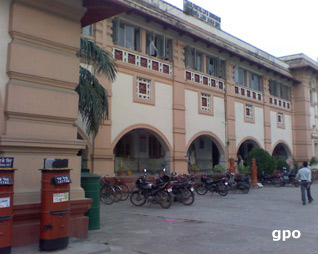
A mere hundred feet further, diagonally across the road from the Pearl, was the entrance to the ’GPO’, the General Post office - an edifice, I found out later, not dissimilar to the one bearing the same name and purpose in Dublin, Ireland. A long driveway through carefully manicured gardens took you to the portico in front of a magnificent building, reminiscent of the British Raj and its imperial architecture.
It housed the post and telegraph offices, as well as the primitive telephone operations.
For me, this was a life-line to the world. As an avid correspondent with pen friends scattered on every continent, and as an insane stamp and first-day-cover collector, I frequented it almost daily and happily surrendered to them all of my personal wealth.
If you continued along the driveway, it threw you back into the chaos of the traffic which, if left to its own machinations, would ultimately spit you out in a few minutes at the gates of the Patna Junction Railway Station. This circus-like complex housed “A.H. Wheeler & Sons”, the only bookstore I knew for much of my childhood years.
If you headed in the opposite direction from our house, away from the theatres, you would soon find yourself outside the Kotwali, the police station, at the first roundabout. Also a relic of the Raj, it had probably served as a mansion for a civil servant at one time. Now, it housed policemen and prisoners, none of whom even noticed the arches, the columns, the keystones or the balustrades that stood mutely, seemingly glad to avoid the attention.
A block further, across the street was the Jaadoo Ghar, literally The House of Magic - the Patna Museum!
Formerly a palace to some local despot, it now housed a princely collection of artefacts from the Maurayan and Gupta dynasties, from the time when Patna was Pataliputra and the eyes of the civilized world were enviously on it. The halls of the museum were sombre and ill-lighted, I remember, not inspiring enough to children to get them to venture into a building which carried severe-looking statues, stuffed creatures of monstrous proportions, and a lot of bones and fossils.
We had declared it a haunted house and rarely went inside, unless absolutely forced to by parent or teacher. Mostly, we limited our visits to playing cricket on its sprawling grounds.
But it did have treasures galore. The 2500-year-old statue at the entrance, of a well-endowed Maurayan woman, was renowned as one of the greatest masterpieces of art of all time, from the subcontinent.
Another exhibit that attracted much attention was the tree-fossil, touted as being two billion years old, and the longest such specimen anywhere.
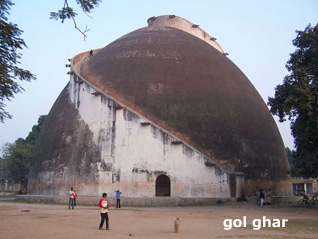
If you carried on further, almost to the end of the road, you found yourself in the shadow of the Gol Ghar, the Round House. A giant bee-hive-shaped granary which you could spot for miles, it had been built two centuries earlier in order to store 150,000 tonnes of wheat. It was the tallest structure in the city … until ugly, modern high-rises came along in the 60s.
You could climb to the top by the dual stairways that girdled it, and enjoy a view of the city and the River Ganges that hurried by only a few hundred yards away.
The ferry terminal where you took an ancient contraption to cross the river, could also be seen in the distance, way past the grounds of the Gandhi Maidan, which served as exhibition grounds and provided ample room for hundreds of thousands during political rallies.
If you looked in the opposite direction, you could see Baance Ghat, literally, the Bamboo Dock. They served as the Burning Ghats, where dozens of the city’s dead were cremated every day.
Towards the river, you could also see the Khuda Baksh Oriental Library, which boasted the only manuscripts that survived the destruction of the University of Cordoba in Spain some five centuries ago.
But you couldn’t see our house from the Gol Ghar because the former was hidden by the mango grove which enveloped our neighbourhood.
Located midway on Budh Marg, it was indeed an island of tranquility.
The immediate surroundings still showed signs of a bygone era.
First, in its name: Bandar Bageecha, the Garden of Monkeys. Much of the original forest was gone, cleared a few decades earlier to make way for the mysterious government-owned textbook publishing complex which lay hidden in the trees across the road from us. But the monkeys had remained, and shared the area with the easily excitable peacocks.
You heard the peacocks mostly at dusk, but rarely saw them, unless it was the monsoons, when they insisted on parading for our pleasure.
The monkeys, of course, were seen and heard! They were thieves who raided our kitchens in the hot summer months, while we’d be asleep deep in the inner labyrinths of our homes, sheltered from the oven of the world outside.
Or, when kept at bay with our catapults and pellet guns, the monkeys would perch themselves a few feet away, in full view, and mimic us until we would burst out in peals of laughter. They would imitate everything we did until we finally fled, finally annoyed at being so accurately mirrored by the scoundrels.
Undoubtedly, Budh Marg has changed much since those days I remember from more than four decades ago.
Pollution, population, progress - all, I believe, have taken their toll.
Conversation about this article
1: Sangat Singh (Kuala Lumpur, Malaysia), June 19, 2012, 4:41 PM.
What a lovely, graphic, nostalgic trip to Sher's Patna. Being poor refugees in 1947, our train had ran out of coal and it stopped at Ludhiana station where we spilled out and struck our roots. I was 14 then. There were two cinemas then: Rekhi and Minerva. There was another, Nau Lakhaa, a Muslim-owned cinema that remained dormant until about 1950. The two cinemas remained the principal source of entertainment, and tickets were 4, 8 and 12 annas each, respectively. As kids, we were banned from going anywhere near the cinema. It was bad for the character. Since it was banned, sneak in we did for the forbidden fruit at every conceivable opportunity. In those days, any film that lasted less than 3 hours was considered bad. There used to be an Interval mid-way and you could go out for a pee, and were issued a coloured re-entry pass. My younger brother, then 11 or 12, bless his soul, had worked out a perfect solution. He would watch only the first half, collect the pass and go home. He had collected all the coloured passes over previous forays, and would saunter in the next day or the day after and check which coloured currency was in use that day to get in and see the other half of the show. A perfect fail-proof system. Even as grown-ups, we teenagers going to the Cinema was not taken kindly by our puritan parents. Usually we went to mid-day shows. They were less risky. In the course of this business, one afternoon on a Sunday, my dear friend Jaswant, who had been renamed Chacha by popular demand, decided to go for the afternoon show. While sneaking out, his two elder brothers who were also dressing up, asked where he was going. The standard answer: "Going to a friend's house." "And Bhra ji, where are you going?" "Oh! We are going to Sabzi Mandi" - referring to the bazaar where they had their shop. Soon thereafter, Chacha arrived at the Rekhi Cinema and queued up for the ticket. A few minutes later, his two brothers also arrived and spotting Jaswant Singh in the queue walked up to him and said: "Buy two more tickets!"