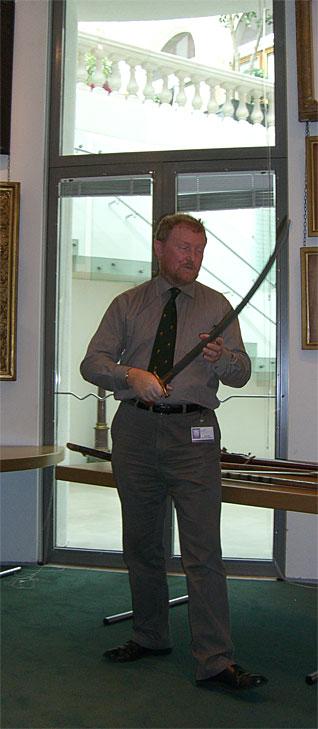
Thumbnail on Homepage: David Edge explaining some of the intricacies of the craftsmanship. All images: courtesy, The Wallace Collection.



Maharaja
Ranjit
Singh
The
Demonstration
Travel
The Treasures of The Emperor:
A Pligrim Through Sikh-British Heritage -
Part VI
T. SHER SINGH
The following is republished from our archives:
PART VI
Post-9/11 Iraq was not the first time that greed led the most powerful nation in the world to trump up false reasons to invade another country, and then to plunder it.
Post-Ranjit Singh Punjab was similarly annexed by the British in 1849. You don't have to take my word that the two "Anglo-Sikh Wars" were no real wars at all, and that minor incidents were blown out of proportion to justify annexing the vast kingdom.
A senior British officer, John D. Cunningham, himself thick in the fraud and concerned over what was being done in the name of the British people, exposed the scheme in his monumental study, The History of the Sikhs.
He was court-martialled and jailed by his senior officers, not for lying or cooking up stories - which he hadn't - but for "revealing state secrets". He died a lonely and broken man, his remains buried in Ambala, Punjab, still waiting to be properly honoured by history.
While John Cunningham languished in prison, Punjab was plundered and entire shiploads were brought to Britain.
Lord Dalhousie, the worst of Britain's Elginesque kleptomaniacs, gave enough baubles to his Queen and to his superiors to keep them at bay. Of the rest - worth hundreds of millions then! - some were sold off in the auction houses of London; some were secreted away to Dalhousie's private castles; and the rest, the bulk of it all, have remained buried and hidden even today, in private and state collections and in storage basements, all over the island.
With a heavy heart, all I can muster is a weak: "Halleluja!"
I shudder to think of their fate if the Indians - and I don't mean North America's native tribes, I assure you! - had inherited them. All one has to do is walk through some of the sub-continent's museums and monuments as they stand today, to get what I mean.
And the icing on the cake is that these treasures are gradually being brought out and displayed in British galleries and museums, and in exhibitions around the world. Slowly, but steadily, they are surfacing ... even though not even one percent of the original loot has see light of the day ... yet.
But, thank God for small mercies!
* * * * *
After a quick but lovely lunch at the Mela Restaurant in London, we are herded off to Manchester Square to see the Wallace Collection.
It is located in Hertford House, an impressive 18th century mansion which had served as home (or rather, one of them) to four generations of Marquesses of Hertford. Each was a collector, and had the wherewithal to pick up truckloads of bargains when successive generations of world-roving kleptomaniacs brought them to London.
The last of the four was the most avid of the gatherers.
Thus, incredible finds came their way after the chaos and anarchy resulting from the French Revolution, for example.
And, when Dalhousie - and others - turned up with ship-loads from Punjab, there were ripe pickings to be had.
Ranjit Singh was fond of beautiful things. Like the Tenth Master he adored so much, he welcomed nothing more than gifts of arms and armour, made by the finest artisans around the world, crafted with the latest materials available to man.
Most of it has ended up in England.
And some of the gems are in the Wallace Collection.
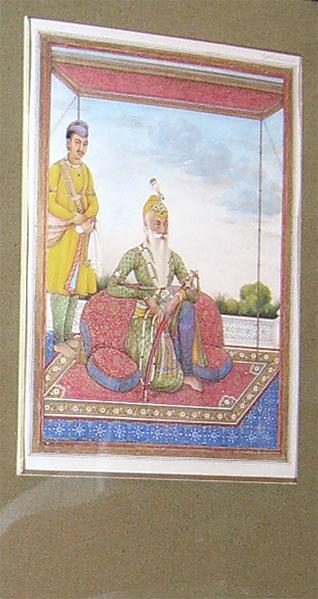
David Edge, one of the resident experts, takes us through a marvellous tour of the weaponry from the sub-continent. Past Tipu Sultan's sword and the Mughal daggers stands a magnificent case with a remarkable 19th century painting of Maharaja Ranjit Singh.
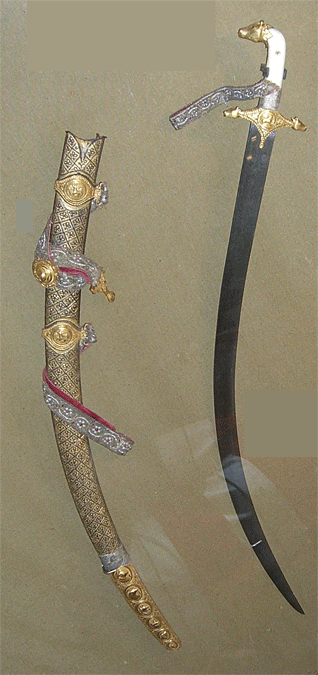
To its left, it is flanked by one of his famous swords, the emblem of a lion on the guard of the hilt. And a golden scabbard alongside.
"The mounts of this sword", says the brochure titled Warrior Kings!, "are all solid gold and its blade is made of 'watered steel', a very special steel said by many to be worth its weight in gold. It was given this name because, long ago, people thought the finely-patterned appearance of the metal resembled water running over pebbles in a stream".
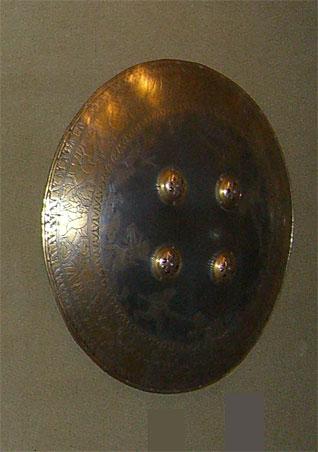
On the right is another masterpiece of craftsmanship, a shield, filigreed in gold. It was made and presented to the Maharaja to commemorate the Sikh Raj.
"The gold decoration includes portraits depicting Ranjit Singh and the most important men of his family and court, together with hunting scenes showing different animals and some of the many weapons used by the Sikhs. Hunting was one of Ranjit Singh's favourite past-times, and was often used by him and his soldiers as a form of training for war".
Further down the gallery are more "weapons and armour used by Sikh warriors".
Next is a Sikh battle helmet, probably - as apparent from its size - used by either a young Sikh boy or a Sardarni. Made of fine steel and intricately inlaid in gold, it has room on its top for a hair top-knot or joorrah.
A kataar - a type of dagger commonly used by Sikhs - depicts a "warrior hunting a tiger from the back of an elephant".
Another fine piece of weaponry - in its craftsmanship and in its deadly functionality - a chukker or quoit stands further to the right along the same case. With a deftly sharpened edge, it was used to great advantage by Sikh warriors. This one, however, appears to have been worn as a ceremonial item around the turban [in the current Nihang and Sikh Regiment style].
Past the kataars and the barchhaas, the muskets and the kirpans and the chukkers, stands the full body armour of a Sikh Sardar. The plates have passages from Gurbani carved in meticulous detail on them.
The full import of these metallic creations hits home when we are taken to another suite, where we're given a demonstration of how each of these items were used, worn on the person or handled.
Even better, each one of us is given an opportunity to handle the items.
Ever tried to hold one of those real kirpans and imagined how, possibly, they could've been wielded by a fully-armoured and armed soldier, perched atop an excited horse, and surrounded by a determined enemy?
I tried to pick up just the body chain-mail, and I confess I couldn't keep it held up for more than a few seconds.
And that was but a fraction of what each soldier took to battle!
Remember, it was hand-to-hand fighting then ... mano-a-mano ... not the wussy stuff that goes on today in the name of courage and bravery.
First published on July 22, 2008; republished on October 18, 2014
Conversation about this article
1: P. Singh (Vancouver, Canada), July 24, 2008, 1:46 PM.
For those interested in watered steel, it is called wootz steel, and was used in the construction of the finest swords at the time. The steel itself was produced in India but over time, the manufacturing process of the steel was lost. As such, there was a limited quanitity of crucible steel available, and highly priced as a result. While the technology behind the making of wootz steel was lost for centuries, modern metallurgists may have discovered ways of creating this particular crucible steel. Wootz steel was the 'true' Damascus steel, and used only one type of steel in production. In time, individuals began pattern-welding, using two different types of steel to produce patterns in the steel and to better its overall quality, and this became known as Damascus steel. On a related note, some of the finest wootz swords were made in Persia/Iran, and the best of the best were made by the Isfahani swordsmith Assadullah during the Safavid period - 16th/17th century. The sword pictured above does not appear to be of Indian origin. It is a shamshir and I would hazard a guess, it may well be of Persian origin; the best Indian swords often had blades of Persian origin. I wonder if the blade has a cartouche on it with the maker's name? Given Maharaja Ranjit Singh's status - it would not be far-fetched to think the blade may have been made by that most celebrated of Persian smiths, Assadullah. I would greatly appreciate any further information anyone can share on this particular sword. Thank you in advance.
2: P.S. (Vancouver, Canada), July 28, 2008, 11:48 PM.
These artifacts belong in Punjab.
3: R Singh (Canada), October 18, 2014, 6:34 AM.
P.S. Ji, you will never see them again if they went to India. They would end up as gifts in the homes of politicians. We have yet to recover the plundered items of 1984, and currently contend with the destruction of the heritage or what is left of it, in the Darbar Sahib complex. Enjoy them in their current safe homes!
4: Sunny Grewal (Abbotsford, British Columbia, Canada), October 18, 2014, 6:30 PM.
@2: Artifacts in India and Punjab go missing all the time from museums and collections. The best place to preserve our heritage is outside of India in a civilized and law-abiding country.
5: Sangat Singh (Kuala Lumpur, Malaysia), October 19, 2014, 5:59 PM.
Sher ji, your description itself is worth preserving ... and luckily we now have tools to save all of our treasures for posterity. All these collections are best preserved in the West wherever they are, instead of in India.
6: Rup Singh (Canada), October 20, 2014, 9:58 PM.
@ 3,4 - I totally agree. SGPC and SAD simply can't be trusted. They have destroyed Sikh heritage (manuscripts, buildings, treasures). And are in connivance with the right-wing Hindu majority, visit deras and fall at the feet of self-proclaimed babas and cult leaders in India and abroad. They are the enemies of the Sikhs.