
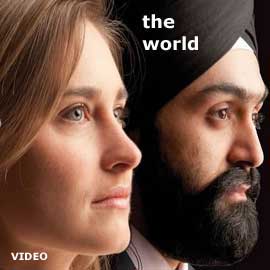
Image below, first from bottom: Muslims worship at the mosque, while Sikhs look on respectfully.



History
This is Sikhi - Let The World Learn
by KHUSHWANT SINGH (Delhi)
On the front page of Syed Shahabuddin's weekly, The Milli Gazette, there was a news item written by its editor, Zafarul Islam Khan, which I felt should have made to the headlines of every national daily and TV channel in India and around the world. But I did not see it appear in any other journal and felt saddened that our media had failed to perform its duty. The article was headlined "Sikhs rebuild mosque demolished in 1947". I give a short summary of its contents.
Sarwarpur, a village ten kilometres from Samrala town in Punjab has a sizeable Muslim population. In the communal civil strife which accompanied the Partition of Punjab in 1947, most of the Muslims fled to Pakistan and the mosque was demolished by rampaging mobs of Hindus and Sikhs. Last year, the Sikhs of the village decided to rebuild the mosque.
On May 22, 2010, Jathedar Kirpal Singh of the S.G.P.C. (Shiromani Gurudwara Parbandhak Committee); the MLA of the village, Jagjivan Singh, and all villagers welcomed Maulana Habibur Rehman Sani Ludhianvi and presented the keys of the mosque to the oldest Muslim villager, Dada Mohammed Tufail. There were triumphant cries of Allah-o-Akbar (God is Great!). Among those present was Mohammed Usman Radanvi, Chairman of the Punjab Wakf Board.
My heart swelled with pride at what members of my community had done. Something what Guru Nanak, whose first disciple Bhai Mardana remained Muslim to the end of his life, would have liked them to do; they had done what the Fifth Guru Arjan, compiler of the Adi Granth and builder of the Harmandar Sahib (today's Golden Temple), whose foundation stone had been laid by the Sufi Saint Hazrat Mian Mir of Lahore, would have applauded. And so would Maharaja Ranjit Singh, one of whose Maharanis built the white marble Dargah of Data Ganj Baksh, the most popular Sufi shrine in Lahore today.
I don't think it is too late for the media to make amends for its oversight. It can still highlight this historic event. Let pressmen and crews of TV channels visit Sarwarpur in Punjab, reproduce pictures of the rebuilt mosque, interview residents of the village and tell all their countrymen what we need to do to keep it together.
They could organise special showings for the destroyers of the Babri Masjid, including L.K. Advani, Murli Manohar Joshi, Uma Bharati, Sadhvi Rithambra, Kalyan Singh, the Hindu Mahasabhaees, Shiv Sainiks, Bajrang Dalis, the RSS, the BJP, and others who share their venomous views. I think the results will be spectacular.
[Courtesy: Hindustan Times]
June 13, 2010
Conversation about this article
1: I.J. Singh (New York, U.S.A.), June 13, 2010, 10:48 AM.
A wonderful initiative by the Sikhs - they make a Sikh proud. And a pithy and pointed report by the veteran Khushwant Singh in his rightly-admired, tightly-worded style.
2: Aryeh Leib (Israel), June 13, 2010, 11:53 AM.
What a magnificent and beautiful expression of the values taught and practised by the Gurus! I recall that one of Gurus (Gobind Singh? - someone in the sangat, please refresh my memory!) who built a mosque, in use till this day, for those of his followers who still retained their previous ties to Islam. The Sarwarpur mosque reconstruction strikes me as being in the same generous spirit of justice and reconciliation. To the Sikhs of Sarwarpur - you have my admiration, and may there be more like you in the world! [Editor: Close! It was the Sixth Guru - Hargobind!]
3: Gurjender Singh (Maryland, U.S.A.), June 13, 2010, 7:33 PM.
This is a strange media in this world. Whenever there is destruction of any religious place, every one knows. But whenever there is a story of rebuilding - such as of the mosque by Sikhs - the news stays with only a few people. The media should wake up and do a better job in carrying out its mandate.
4: Surinder Sikand (Foster City, California, U.S.A.), June 14, 2010, 2:20 AM.
This one is the best news I've heard in a long time. This really postulates the message from Guru Nanak, "Koi aakhe ram ram koi allahai". When performing good deeds, we Sikhs should do it with an open mind without any prejudice in terms of origin, race, color, gender or life style. That is the message for us from our Gurus. Well done, Sarwarpur Sikhs!
5: Sangat Singh (Kuala Lumpur, Malaysia), June 14, 2010, 7:12 AM.
'Prabh kai simran ridh sidh na-o nidh' [GGS:262.17]. This incident took place at Toba Tek Singh (Pakistan) at the end of the 19th century, when a canal system was built by the British. People all over Punjab thronged there when the farmlands were allotted to them. Also came the poor farmhands looking for work. Among them was a poor Muslim, Ari, by the full name of Abdul Karim from Jalandhar, desperately looking for work. One day, he was found sitting at the threshold of the gurdwara where Sant Sangat Singh ji of Kamalia did 'katha'. At the end of the kathaa, while going out, Sant ji spotted this dejected human being and asked if something was troubling him. He started to relate his sad story but Sant ji stopped him and told him to follow him as he was going for his usual walk, and he could relate his story then. Ari said that he had arrived some five days ago and was driven away from the Hindu Temple and the Mosque. He at last found a shelter in the House of Nanak, where he had a roof and meals. He had been listening to Sant ji's katha for three days and was totally bowled over. He was destitute. He was married for 12 years but had no children. He was waiting for the opportunity to touch the Sant's feet and seek his blessings. He saw in him, Sant ji, 'Allaha da walay'. Sant ji asked him if he could read or write. Ari replied that he had studied up to 'teeji jammat' (3rd grade). "All right then, write on a piece of paper this 'kalaam' - 'Prabh kai simran ridh sidh na-o nidh' and start doing simran om it immediately, and at all times," Sant ji told him. Ari, by the time he returned to the gurdwara, had memorized the line and got deeply immersed in it. He also retrieved an old 'tasbeeh' (rosary) and got totally lost in it. The very next day, at the end of the divan, an army subedaar saw him and asked who had given him this kalaam. He related the previous day's encounter with Sant ji. The subedaar said that he was looking for a man to work on his fields and offered him a job there and then. Abdul Karim put his heart and soul in his job but never for a minute abandoned that wonderful kalaam. Within months, the fields started yielding more crop, and he got an immediate raise in his salary. Also, the subedaar gave him a plot of his own to work on and within a few years, due to his honest and hard work and loyalty, became a 'numberdaar' and owner of his own fields. He also had four children by then. In 1908-09, he made a special thanksgiving trip to Kamalia to visit Sant Sangat Singh ji and said that he had now all the worldly wealth but had a void and now he wanted something for his 'lok' and 'pralok'. "Here and hereafter." Sant ji said, "you go to the next line: 'Prabh kai Simran gin dhian-aan tat budh' [GGS:262.170] - 'Remembrance of God consists of knowledge, meditation and the essence of wisdom." [Source: 'Kathriayan Sant-an' - Biography Sant Sangat Singh ji Kamalia, vol. 1).
6: Surinder (Massachusetts, U.S.A.), June 14, 2010, 12:37 PM.
Very inspiring story. Yes, it is true that the Sixth Master built a mosque for his Muslim soldiers. After the Partition of Punjab in 1947, this mosque was abandoned as Muslims had all gone to Pakistan. Sikh Nihangs took over and used it as a gurdwara. Recently, only about in the last decade or so, Sikhs - with the help of the famoust Sikh Restoration Architect, Gurmeet Kaur Rai, repaired and restored the mosque ... and gifted it back to the Muslim community. This is the historical Guru-ki-Maseet in Punjab. But that also brings me to my next question: Is there any possibility that the Pakistani Muslims will reciprocate and give back the gurdwaras they have taken over?
7: Tejinder Singh Khalsa (New Delhi, India), June 14, 2010, 1:33 PM.
Great job ... Proud to be a Sikh!
8: Sangat Singh (Kuala Lumpur, Malaysia), June 14, 2010, 8:10 PM.
For those of the post-partition era, the name of Toba Tek Singh does invoke warm feelings. The name was retained despite renaming the many names given after British Rulers. For example: Montgomery became 'Sahiwal', Lyallpur became 'Faislabad'. Toba Tek Singh remained because of the Gurmukh, Bhai Tek Singh who served water and provided shelter to the worn out and thirsty travelers passing by the small 'Toba' or pond that became 'Toba Tek Singh'. I believe there is also a park somewhere named after Tek Singh ji. I also remember as a kid when Toba Tek Singh was connected with Lyallpur with a railway link. But, during World War II, the railway lines were uprooted and donated towards the War effort elsewhere. I hope it is re-linked now.
9: Chattar Singh Sahni - Khanpuri (Roslyn Heights, New York, U.S.A.), June 18, 2010, 5:35 AM.
The building of the mosque by Sikhs demonstrates and re-comfirms the largeness of the Sikh heart and mind and the universality of the Gurus' teachings.
10: Tarlochan Singh (Leamington Spa, England), June 19, 2010, 9:57 AM.
Wonderful article. I am extremely pleased and feel proud. Thanks to the writer.