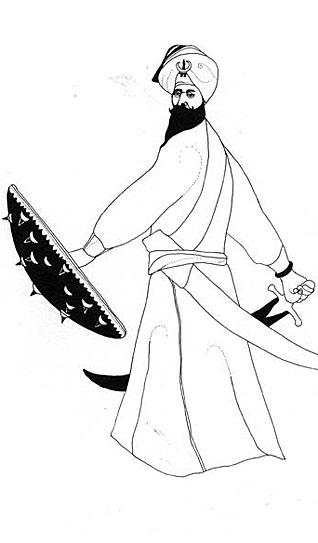
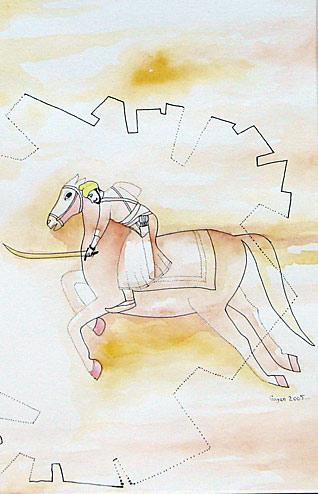
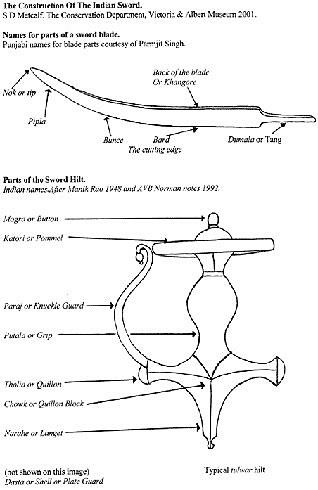
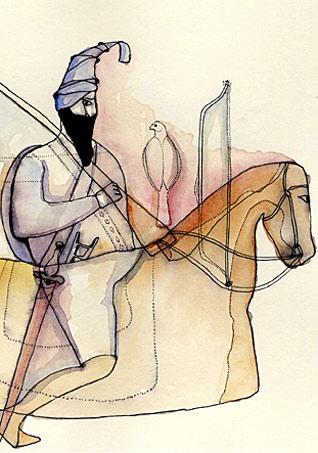
All Nihang drawings are by Gagandeep Singh. The sword diagrams below are by Simon Metcalfe.



History
The Birth of Gatka -
The Martial Arts of the Sikhs
by NIDAR SINGH
The following gives a glimpse into the making of Nihang lore and mythology - an askewed view of history and traditions, consciously created to support a specific, limited mindset and environment.
Shastar Vidya (knowledge/science of weaponry) was essential military training for the historical Sikh warrior - the Akali Nihang. The present-day heirs of these centuries-old traditions, the Buddha Dal, trace the origins of Sikh Shastar Vidya to the founder of the religion, Guru Nanak himself.
According to their oral tradition, Guru Nanak was summoned to the divine court of God where, along with receiving the holy gurmantar, "Waheguru", he also received Shastar Vidya.
The Nihangs further believe that Guru Nanak passed this martial knowledge on to his disciple, Baba Buddha, with the stated intention of claiming it back in his sixth form. It was the sixth Guru, Hargobind, who then received the skills and techniques from Baba Buddha at an early age. The Grand Old Sage also trained an army of twenty-two hundred "saint-soldiers" of the Akal Bunga (the "Immortal" Fort, built in 1606) ... and they came to be known as the Akalis (Immortals).
The Akali army was called the Akal Fauj, but was informally known as the Buddha Dal or the army of Baba Buddha. Its primary function was to defend Sikhism and all who sought the protection of the Sikhs from the then tyrnannical Mughal empire which had, by then, tortured and executed the fifth Guru, Arjan. It was his son, Guru Har Gobind, with his army of Akalis, who engaged the Mughal forces in four battles and gained victory on each occasion.
With the successive Gurus after Har Gobind, the Akal Fauj was maintained in its original form until the time of the tenth Guru, Gobind Singh. At some time before the creation of the Khalsa in 1699, he altered its structure with the effect that, from then on, only a high-ranking soldier was to be known as an Akali. A low-ranking soldier was designated Nihang, or one who is neither attached to life nor fears death.
He quickly realized that in order to defend Sikhism, it would not be enough just to rely on the Akal Fauj. So, he decided to make the whole of the Sikh nation (with the exception of certain groups such as the Udasis, Seva Panthis and Nirmalas) into a martial nation. Thus, in 1699, the Khalsa came into being.
After Guru Gobind Singh, it was a successful Khalsa, led by the Akalis, who fought a life-and-death struggle for nearly a hundred years against both the Mughal Empire and the invading Afghans. They forged a series of independent kingdoms throughout the Punjab, by the closing decades of the 18th century.
Even when the great Sikh kingdom of Maharaja Ranjit Singh fell to the British in the hard-fought "Anglo-Sikh Wars" (1845-46 and 1848-49), the majority of Sikhs, to this day, know it was not the martial prowess of their ancestors that let the nation down. Historical evidence unequivocally points to the fact that the Sikh army actually won on the battle-fields but lost the wars, due to the betrayal of their treacherous Dogra generals.
Following the annexation of the Punjab in 1849 and the establishment of the British Raj, the traditional Sikh martial arts and their practitioners suffered greatly. In order that the British authorities could establish their rule in the Punjab, they adopted several severe measures, the most significant of which was the effective disarmament of the whole of the Sikh population. Even everyday tools and farming implements which could be used as weapons were banned.
A few, such as the Akali Nihangs, who refused to surrender their weapons, were hunted down and killed or driven into hiding by the British authorities. It was at this critical juncture that the traditional martial knowledge, Shastar Vidya, previously maintained to a high standard by the Sikhs, almost ceased to exist in the Punjab.
In 1857, the Indian Mutiny erupted. By that time, the British had significantly crushed all resistance to their rule in the Punjab, with the help of soldiers from the other states around the sub-continent. Thus, feeling no loyalty to the pockets of uprisings amongst their former tormentors, those Sikhs who willingly collaborated with the British became fully established as the leaders of the "new" Sikh nation.
Thus, in 1857, the Sikhs greatly assisted the British in crushing the mutiny.
As a consequence of this assistance provided by the Sikhs, restrictions on martial practices were relaxed in the Punjab, but tightened in north-eastern regions of India where the mutiny had been strongest. However, the Shastar Vidya which re-emerged after 1857 in the Punjab had changed.
This new form was a product of the changing times, which had also seen the general Sikh populace of that period begin to accommodate the British Raj by divorcing itself from the sanatani boh-Panthi (traditional pluralistic) Sikh practices of the pre-British period.
There was a stark contrast between this pluralistic and undeveloped phase (consisting in the main of Udassis, Seva Panthis, Nirmalas and Akali Nihang Singhs) and the renaissance which was later initiated and encouraged by the Tat Khalsa and the Singh Sabha Movement.
[It should be noted that this was the first extended period of peace and consolidation of its institutions by the Sikh community-at-large since its very inception under the Gurus.]
The new Shastar Vidya was no longer the lethal art designed to produce soldiers to defend the Sikh nation. Instead, during the 1860s, it had evolved into an inoffensive and ritualistic martial art popularly known as Gatka (derived from the name of the main weapon used, the sword training stick). Gatka was mainly practiced in the barracks of the British Indian army and was diligently taken up by Sikh and other Indian soldiers.
Later, as Sikh educational institutions - schools and colleges - opened in the Punjab during the 1880s, European rules of fencing began to be applied to Gatka. This innovation led to the development of the two branches of the art and science of Gatka, namely: rasmi (ritualistic) and khel (sport).
Adapted from "An Introduction to Shastar Vidya - The Education of a Sikh Warrior", a lecture by Nidar Singh, given as part of the Sikh Arts and Heritage Lecture Series at the Victoria & Albert Museum.
As part of the same lecture series, Simon Metcalfe gave a talk focusing on the making of Damascus steel and the weapons traditions in Punjab and other parts of Northern India. The above diagrams (see second box from bottom, on the right), showing the construction of the traditional kirpan, were part of that lecture.
[Courtesy: The Victoria & Albert Museum, London, England]
Conversation about this article
1: Gagandeep Singh (West Bromwich, U.K.), January 04, 2009, 4:05 PM.
I learn gatka ... it is the best!