
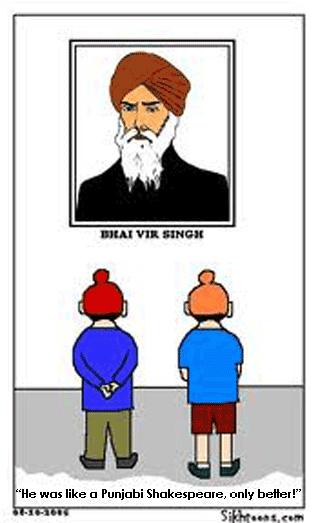
Cartoon below: courtesy, SikhToons.




Books
Punjabi Literature ... Through Ray-Ban Glasses
by RANA NAYARConversation about this article
1: Devinder Singh (India), August 07, 2011, 10:34 AM.
To appreciate your literature, you need a reference point. The best way is to read the best of other cultures and languages as well, and cross-reference your own. Rather than 'looking through' tinted Ray-Ban glasses, developing multilingual reading skills is the way to develop the 'export surplus'. Speaking in the language you are learning and reading its literature is the best way to learn it.
2: Sangat Singh (Kuala Lumpur, Malaysia), August 07, 2011, 10:58 AM.
The time: pre-Partition of Punjab. The School: Khalsa High School, Lyallpur. In this school, once Master Tara Singh was the teacher, hence 'Master'. We had another headmaster who, when teaching English, also translated everything into Punjabi by force of habit: "Come here," he would say. "Iddhar aa-o! Go there. Uddhar jaa-o!" A student asked him: Master ji, why do you translate everything you say in English, into Punjabi? The reply: "This is my habit. Eh meri aadat hai!" Now, of course, in Punjab 'Bihari' is taught that way, I'm sure.
3: Harpreet Singh (Shillong/ Bareilly, India), August 07, 2011, 10:58 AM.
Good article, raising an important issue. I have lived outside Punjab my entire life, barring occasional visits to Punjab. My learning of Punjabi happened by reading the "Punjabi Tribune" at my maternal grandparents' place during summer holidays in Haryana. But I started to seriously love my languauge (Punjabi) seeing South-Indians in my Engineering College put up signs in their native language in the hostel register. I felt ashamed I did not know how to write Punjabi. Thereafter, in addition to learning how to write Punjabi, I made a sincere attempt to read Punjabi Literature, and I continue on my journey.
4: Gobinder Singh (U.S.A.), August 07, 2011, 1:17 PM.
The attitude of Punjabis themselves towards Punjabi language and literature is the main factor in this "self-inferiorization". I have witnessed it on my trips to Punjab every few years. Teachers in schools and parents at home tell their kids to speak English or Hindi, at the expense of their mother-tongue. If you ask local Punjabis about their favorite books or what they are reading these days, the response is always some English language "foreign" book. I have to go to local book stores and dig deep through their meagre stocks to find some new Punjabi books. Interestingly, when they saw my 2-year old daughter speaking fluent Punjabi in Punjab, they were amazed and sheepishly said that our kids are not allowed to speak Punjabi in schools, so they loose touch. That must be the case, because in the U.S., every school-kid is required to speak Punjabi ... right? ;-)
5: Harinder (Uttar Pradesh, India), August 07, 2011, 1:30 PM.
Let them prescribe all the translated books from different language and cultures to Punjabi in the curriculum of Punjab's school and colleges. This will give a boost to the economics of literature and publishing. It will also add new words, grammar, concepts, etc., to the Punjabi language.
6: Kuldip (Crawley, United Kingdom), August 07, 2011, 4:40 PM.
I think in the West, at least to some extent, the tide is turning and there is some pride in Punjabi. Radio stations such as Desi Radio in Southall, U.K., are doing this. Roop Singh Dhillon can be held up as an example. All the singers and musicians in the West can also be given credit. The inferiority complex is in Indian and Pakistani Punjabis and perhaps the generation that immigrated out to the West. Bhangra is big only because of the West. Sikhs in Britain wear their turbans with pride. Ones in Punjab shed the turban for no reason. Until our people learn to love to read, its literature will suffer.
7: Hardev Singh Virk (Surrey, British Columbia, Canada), August 09, 2011, 10:53 PM.
I fully agree with Rana Nayar's three suggestions. Recently, I attended the International Punjabi Conference held at Toronto (August 5-7). Our Canadian bus driver was a woman and she used to read her book when the bus stopped for a coffee break on our way to Ottawa for sight-seeing. All our delegates enjoyed bawdy jokes throughout this journey of 6 hours, but not one opened a book! We publish almost a thousand books in Punjabi every year but you will not find even a thousand readers for each in the whole of Punjab! It is true that the Indian Public School system lays stress on learning of English at the cost of the mother-tongue. Punjabi is not a language of business and employment anywhere, hence its neglect. This conference failed to provide any concrete suggestions to help pull the Punjabi language out of its present state of affairs. The situation in Pakistani Punjab is even worse, as told by delegates from Pakistan.
8: Simran (Oceanside, California, U.S.A.), August 17, 2011, 9:58 PM.
The status of Punjabi in the state of Punjab is even worse. I was there last December and saw more and more kids speak in Hindi or English. My own nieces and nephews admitted to me that the teachers scolded them and their parents repeatedly for speaking in Punjabi at home. There were fewer signs in Punjabi at public places and more in English and Hindi. In a way, its not that bad because our ten Gurus employed the Gurmukhi script but were multi-lingual (all of them).
9: Roop (Reigate, United Kingdom), January 27, 2014, 8:47 AM.
As far as I can see, our readng habits have not changed / improved. If I try and promote my own books for example, people either expect them for free or rather not buy them, as literature is seen as unprofitable ... by that, I mean, reading it,