




Books
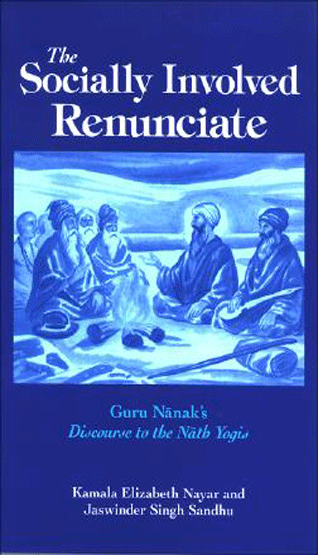
The Socially Involved Renunciate:
Guru Nanak's Discourse to the Nath Yogis
A Book Review by SUSAN PRILL
The following is offered as sikhchic.com's Book of the Month selection for July, 2010
THE SOCIALLY INVOLVED RENUNCIATE: GURU NANAK'S DISCOURSE TO THE NATH YOGIS, by Kamala Elizabeth Nayar and Jaswinder Singh Sandhu. State University of New York Press, 2007.197 pp., $60.00. ISBN 978-0-7914-7213-2
THE BOOK REVIEW
Although Guru Nanak has received a fair amount of attention from scholars such as W. H. McLeod and J.S. Grewal, this book represents the first time that one of Guru Nanak's longer compositions has been the sole focus of an academic study published in the United States.
The text is structured so as to be accessible to non-specialists, with four chapters of introduction to religious context, two chapters specifically on the Siddh Gosht, a complete translation of the Siddh Gosht itself, and a useful glossary at the end. The stated purpose of the book is to advocate for the use of the Siddh Gosht as an introduction to Sikh scripture, much the way the Bhagavad Gita is used for Hinduism.
The book is therefore largely targeted at undergraduate students of Indian religions. This large target audience requires the authors to be both brief and broad in their scope, which may frustrate more experienced scholars of Sikhism.
The Siddh Gosht is one the longest compositions in the Guru Granth, and its seventy-three stanzas are structured as a discourse between Guru Nanak and an assembly of Yogis of the NÄth sect. The Yogis initially try to impress Nanak with their powers, and eventually ask him for instruction, inquiring ‘Who are you? What is your name?/ What is your path? What is your
goal?' (117).
The text develops along lines familiar from other texts in the dialogic tradition of Indian philosophical writing, such as the Bhagavad Gita, so that the Yogis' questions are asked primarily to set up Nanak's relatively lengthy answers. Nayar and Sandhu see their task as an unpacking of the context of the Siddh Gosht aiming to make both the Yogic content and Nanak's
teachings accessible to a larger audience.
The Siddh Gosht is an interesting text for this sort of project as it represents a conscious attempt at dialogue between the first Sikh Guru and one of the most prominent religious communities of his time. By engaging with the teachings of the Nath Yogis, Guru Nanak is able to expound upon the nature of renunciation, the experience of Truth, and the behavior of the gurmukh (one who is oriented towards the Guru, a common term for the ideal devotee in early Sikhism).
Nayar and Sandhu open with a typology of renunciation (5), placing Sikhism together with Bhakti and Mahayana Buddhism in the category of renunciates who live in society (as opposed to the usual assumption that Sikhism is a householder religion).
They persuasively argue that the ideal Sikh is unlike a formal renunciate, but also unlike the classical high-caste Hindu
householder, who is expected to ultimately withdraw from society (13-16).
The discussion of renunciation in this chapter would be a welcome addition to an introductory class on South Asian religions, and thus fits well with the stated audience for this book. This framework of renunciation forms the basis for the later analysis of the Gosht, which is set as a discourse between Guru Nanak and an assembly of yogis.
Perhaps the least successful part of the book is the chapter on Nath Yogis. The authors rely heavily on the well-known study of Yogis done by Briggs in 1938, but do not clearly differentiate between the early twentieth-century Nath sect and those of Nanak's time. They also treat Briggs occasionally as current scholarship, with awkward results such as referring to a town
in Pakistan as being a current site of Nath pilgrimage (29), and usage of British colonial terms such as ‘Rajputana' for Rajasthan (27). These sections are interspersed with ideas drawn from the more current work of David Gordon White, but the chapter as a whole makes it clear that there is a real paucity of current work on the Yogis of Nanak's time. In a book of this length, it is impossible to treat this topic fully, but it is puzzling that the authors make such extensive use of Briggs' research without acknowledging its historical context.
While they acknowledge more critical treatments of these sources, Nayar and Sandhu provide a very sympathetic treatment of the janam-sÄkhÄ« tales of Guru Nanak's life, treating them as largely reliable sources for establishing the chronology of Guru Nanak's travels (45).
Their primary concern in analyzing these stories is determining the occasion on which Guru Nanak might have recited the Siddh Gosht. The authors catalog a number of encounters with Nath Yogis mentioned in the various janam-sÄkhÄ«s and in other sources for Guru Nanak's life (53), weighing which might have prompted this long and famous composition.
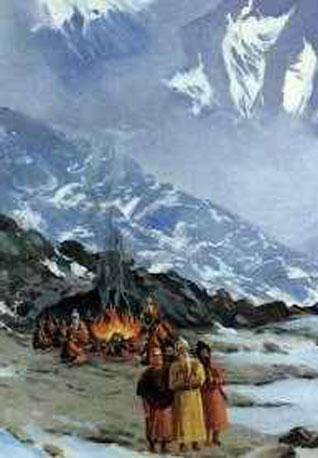
After weighing the two most popular contenders, the fair at Achal Batala and a visit to Mount Kailash (in lieu of the mythical Mount Sumeru), the authors conclude that the composition probably postdates Guru Nanak's travels, and might represent a compilation of Guru Nanak's various encounters with Nath Yogis. This hypothesis is an interesting one, but it would have been helpful to see more evidence of how the authors reached this conclusion.
The authors use the Siddh Gosht as an entry into Guru Nanak's historical and religious context and into his teachings on a wide variety of subjects. Because the text itself is quite wide-ranging, it serves as a good entry into Guru Nanak's thinking. They draw on Guru Nanak's writings, as well as more recent Sikh practices such as verbal repetition of the mantra ‘Waheguru' to illustrate points of continuity with Nath Yogic practice (89-91). This represents the strongest argument of the book, and it is a point which has received relatively little attention elsewhere.
By exploring those ideas shared between the Nath Yogis and the nascent Sikh community, Nayar and Sandhu add another strand to the continuing debate about Guru Nanak's relationship with groups like the sants and the sufis that were prevalent at the time.
The book concludes with a full translation of the Siddh Gosht itself. While the Siddh Gosht has been translated in full elsewhere, this represents the first time that it has been the subject of a monograph released in the West, and it is certainly worthy of this treatment. The translation is broken into topical sections for ease of reference, and retains a good deal of Sikh technical
vocabulary, explained in the glossary.
For example, the translators use the term ‘Ek Oankar,' rather than ‘God' or a near synonym thereof, to emphasize that Guru Nanak's theology is not Judeo-Christian monotheism. While this is an atypical way of addressing this problem, it is effective in retaining the distinctive flavor of the text.
Methodologically, this book attempts to position itself between ‘traditional historians' (like Trilochan Singh) and ‘critical historians' (such as McLeod and Pashaura Singh). The differences between these two are described briefly. In trying to find a middle ground, it incorporates ideas from giÄnÄ«s, traditional interpreters of Sikh texts, arguing that gianis provide important
insight into ‘the Guru Nanak of Faith' (16-18).
The late Giani Sant Singh Maskeen seems to have been the primary giani consulted, and is cited at numerous points in the volume. This approach works quite effectively in the sections treating current interpretation of the Siddh Gosht itself, and adds a new perspective to the debate about the context for its composition. The inclusion of the gianis' interpretations allows the text to be treated as part of a living tradition.
The Siddh Gosht has been translated by a number of other scholars, most recently by Shackle and Mandair in their Teachings of the Sikh Gurus (Routledge, 2005). The Nayar and Sandhu translation reads more as a prose translation than the Shackle and Mandair translation and contains more untranslated terminology. The translation may therefore be slightly less accessible to the uninitiated, but may allow for points of comparison with other South Asian texts.
For example, one could compare Guru Nanak's use of the word sunn (‘emptiness,' a term strangely missing from the otherwise very good glossary) with Buddhist uses of the same term.
The Socially Involved Renunciate is a welcome contribution to the small body of works on Guru Nanak, although it suffers at times from poor editing and from an inconsistent theoretical framework. This last concern is more likely to bother more experienced scholars. The book works well as an introduction to Guru Nanak's writings, and could be used in a classroom setting for that purpose with some guidance.
Susan Prill is at the Juniata College, Huntingdon, PA, U.S.A.
[This book review is reproduced here with the courtesy of the journal, Sikh Formations: Religion, Culture and Theory, Issue 6.1, 2010, published by Routledge. ]
June 29, 2010
Conversation about this article
1: Sangat Singh (Kuala Lumpur, Malaysia), June 30, 2010, 9:12 AM.
'Sab tay vadaa satgur Nanak jin kal rakee mayree' [GGS:750.4] - Guru Nanak is the greatest of all; He saved my honour in this Dark Age of kalyug'. The earliest signs of renunciation were seen with the 'sacha sauda' incident and went on with 'tera tera' when he managed the Modi Khaana as the Sultan's Store Keeper General. Giving up a householder's life and becoming an ascetic and living in isolation for the traditional 'sages' was no renunciation because they still had to go back to the ordinary householders with their begging bowl for food, to the very ones they had abandoned. Guru Nanak's renunciation was the inner one. Principal Satbir Singh has beautifully described the true renunciation in his book 'Gur Bharee'. Sant Samrath Ramdass happened to meet Guru Hargobind at Srinagar (Garhwal) in 1634. Fully armed and riding a horse, the Guru had just returned from an excursion. "I heard that you occupy the Gaddi of Guru Nanak," said Ramdass, who was a renunciate and a 'tyagi'. "But you wear arms and keep an army and horses. You allow yourself to be addressed as 'Sachaa Patshah' - the True King. What sort of Guru are you?" asked Ramdass. Guru Hargobind replied: "Inernally a hermit, and externally a prince. Arms are for the protection of the poor and destruction of the tyrants. Baba Nanak had not renounced the world but had renounced Maya and self ego." - 'Batan faquiri/ zahir amiri/ shastar garib ki rakhiya/ jarwan ki bhakhiya/ Baba Nanak sansar nahi tyagaya/ Maya tyagi thi". To this, Ramdass spontaneously said: "This appeals to my mind!" - 'Yeh hamare man bhavti hai'. This was the same message of Guru Nanak when he met Gorakhnath. The message of a true renunciation lovingly imparted in the Siddh Gosht. This is just a preamble. I have still to write how Guru Nanak equipped himself and Mardana suitably with mountaineer's gear. All described in Principal Satbir Singh's 'Bal-aoo Chiragh' when he planted the flag on 'Sumar Parbat'.
2: Surinder (Massachusetts, U.S.A.), June 30, 2010, 11:38 AM.
Respected Sardar Sangat Singh ji (Kuala Lumpur, Malaysia) mentioned Sant Samrath Ramdass. I just wanted to add that the same Samarth Ramdass, who was a Maharashtrian, came back home and imparted the same knowledge to Shivaji. He was Shivaji's Guru. Shivaji, as most people would know, was the Marathi warrior who stood up to the Mughals (Aurangzeb).
3: Sangat Singh (Kuala Lumpur, Malaysia), July 01, 2010, 8:05 AM.
Surinder jio, I did think of that but stopped short as Maharashtraians had already started to compare and equate Guru Gobind Singh with Chhatarpati Shivaji. I thought that would open a Pandora's Box. As for Guru Nanak's mountaineering expedition, he had equipped himself with a strong rope, a snow pick, a sturdy leather belt equipped with hooks. And, of course, suitable winter apparel. Bhai Mardana was similarly equipped, in addition to carrying his Rabab, for the 'Fire Nights' to sing the celestial bani. What a wonderful journey to that bearded 'Nath' lion in his own den, good and proper together with his flock. They begged him to stay on but Guru Nanak had more mountains to climb and many more miles to go.